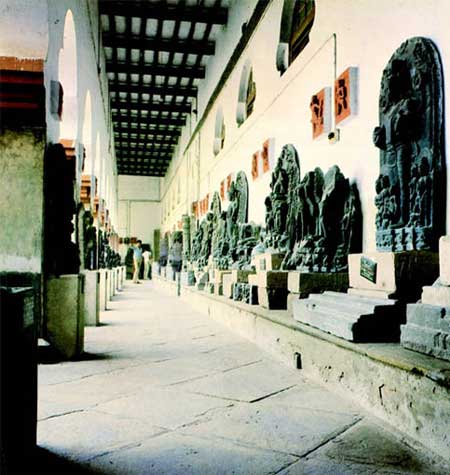
Bangladesh National Museum
 preserves and displays the cultural property and heritage, as well as specimens of natural history of Bangladesh. Its mission is to establish a bridge between the past and the present and uphold the national tradition and culture. The
museum itself has a history, which began with the establishment of
Dhaka Museum on 20 March 1913 with an annual government grant of Rs 2,000. The Governor of Bengal, LORD CARMICHAEL, formally inaugurated the
museum on 7 August 1913 in a room of the Secretariat Building (at present, the DHAKA MEDICAL COLLEGE AND HOSPITAL).
The plea for setting up a museum in DHAKA was first made in the newspaper The DHAKA NEWS on 1 November 1856. In 1909, a few coins were transferred from Shillong to Dhaka, and a suitable place was needed to preserve them. H E Stapleton, a famous numismatist made a proposal to Governor Sir Lancelot Hare on 1 March 1910 to establish a
museum in Dhaka.
In the first meeting of the general committee held on 3 March 1914, a decision was taken to request the Bengal government for a grant of Rs 5,000 to cover the development expenses of the museum for 1914-15. The first meeting of the executive committee was held on 19 May 1914. At this meeting the draft budget for the year 1914-15 was prepared and a decision was taken to appoint a curator. NALINI KANTA BHATTASALI joined as the first curator of
Dhaka Museum on 6 July 1914, with a monthly salary of Rs 100. Although the museum was inaugurated on 7 August 1913, it was opened to the public on 25 August 1914, with 379 objects on display. A total of 4,453 people visited the museum in 1914-15; among them 143 were female.
A large portion of the budget of the museum comes from the government as grant. The sources of the
museum's own income include the rent collected from the four auditoriums and other buildings and sale of entry tickets. The director general is the chief executive of the
museum. It has four branch museums: Osmany
Museum at SYLHET; AHSAN MANZIL
Museum in Dhaka; Zia Smriti
Museum in CHITTAGONG, and the Shilpacharya Zainul Abedin Sangrahashala at MYMENSINGH. The number of foreign and local visitors at the
museum average 2,345 a day. For rural people, the
museum organised a Mobile Exhibition in 1979 with a special bus containing a Mini
Museum of 28 small galleries. The objective of this programme was to make the masses familiar with the culture and tradition of
Bangladesh.
The important objects under the Department of Contemporary Art and World Civilisation include paintings and sculptures of Shilpacharya Zainul Abedin, Quamrul Hasan and artist S M Sultan and artworks and reproductions of works by renowned artists from home and abroad; potteries burnt during the Second World War in Hiroshima of Japan and various local and foreign objects collected from Bangabhaban.
Objects supervised by the Department of Natural History include mapping of rocks, minerals and population of
Bangladesh; geological map of
Bangladesh; water colour paintings of rural
Bangladesh; stuffed Royal BENGAL TIGER of the Sundarbans, chitral deer, honey bee, PEAFOWL, CATTLE and birds, fruits and flowers, butterflies, pet animals, marine mollusc, elephant, monkey, LANGUR and the skeleton of a whale. Two other departments are Conservation Laboratory and Department of Public Education. The laboratory looks after the restoration of
museum objects using scientific methods. The Department of Public Education conducts
museum-related education programmes for the public and students. This department has seven sections: education, display, library, publications, audio-visual, auditorium and photography. The Department of Public Education organises seminars, symposia, exhibitions, competitions and educational and cultural functions.


 Bangladesh National Museum preserves and displays the cultural property and heritage, as well as specimens of natural history of Bangladesh. Its mission is to establish a bridge between the past and the present and uphold the national tradition and culture. The museum itself has a history, which began with the establishment of Dhaka Museum on 20 March 1913 with an annual government grant of Rs 2,000. The Governor of Bengal, LORD CARMICHAEL, formally inaugurated the museum on 7 August 1913 in a room of the Secretariat Building (at present, the DHAKA MEDICAL COLLEGE AND HOSPITAL).